Modernizing Financial Analytics Infrastructure: Informatica to Microsoft Fabric Migration
 0|
0| 0
0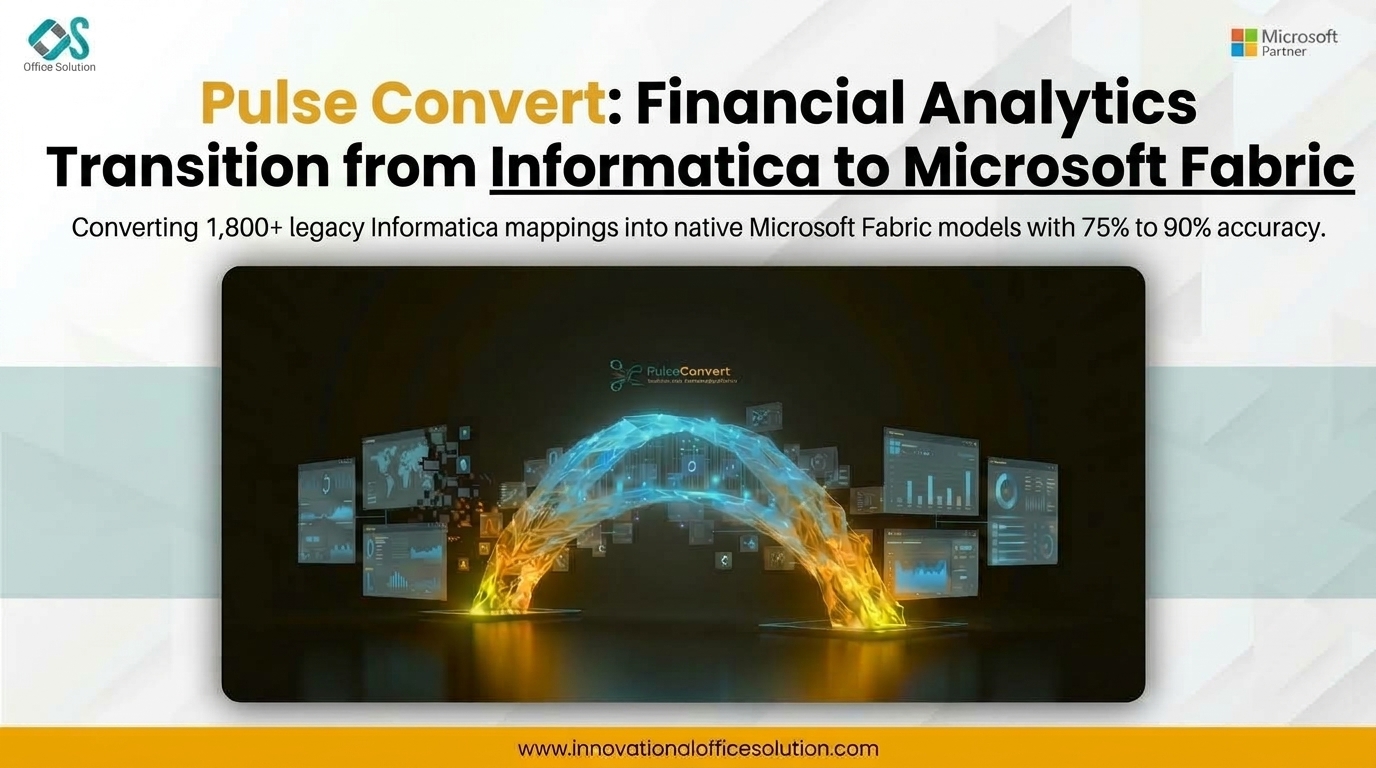
Table of Contents
Executive Summary and Client Background
A major regional financial services provider operated an extensive data processing ecosystem anchored by legacy Informatica PowerCenter and Informatica Intelligent Cloud Services (IICS). Across twelve years of institutional growth, the organization built over 1,800 active mapping routines, 350 session tasks, and complex workflows feeding regulatory compliance engines and executive reporting suites.
The legacy architecture presented mounting operational and financial friction. Annual software licensing and maintenance contracts for Informatica had climbed significantly, while the multi-layered platform required dedicated infrastructure management, continuous server tuning, and specialized administrative oversight. Furthermore, batch processing windows were routinely overflowing into trading hours, delaying critical risk assessment reports.
To modernize their data estate, cut operating overhead, and enable real-time predictive analytics, leadership commissioned an Informatica to Microsoft Fabric migration. The core objective was replacing traditional ETL server architecture with a unified, SaaS-driven analytics framework leveraging OneLake, Fabric Data Factory, and Fabric Data Engineering.
Architectural Challenges Pre-Migration
During the initial technical audit, enterprise data architects highlighted three primary structural roadblocks in the existing setup:
- Proprietary Transformation Logic: Core business logic was trapped inside proprietary Informatica XML mappings, complex user-defined functions (UDFs), and nested expression transformations that lacked direct 1:1 code equivalencies in standard SQL environments.
- Infrastructure and Licensing Costs: Operating separate staging servers, secure agent clusters, and row-based licensing models produced escalating total cost of ownership (TCO) without yielding improvements in processing speed.
- Siloed Analytical Ecosystem: Analytical teams had to continuously move transformed data across external databases to power downstream reports, resulting in redundant copies and increased risk of data drift across business units.
The Migration Strategy: Leveraging Pulse Convert
To eliminate the manual labor of hand-coding thousands of ETL mappings into cloud pipelines, the implementation team deployed Pulse Convert, an enterprise migration engine engineered specifically for complex analytical modernizations.
Rather than re-architecting workflows from scratch, Pulse Convert parsed legacy Informatica XML definitions, mapped complex transformation nodes, and converted proprietary logic directly into native Microsoft Fabric artifacts.
Across the client's repository, Pulse Convert evaluated all 1,800+ mappings and achieved an 86% automated conversion accuracy, staying well within its established Pulse Convert 75% to 90% accuracy operational benchmark. The remaining 14%—consisting primarily of custom external script calls and legacy C++ extension modules—was manually refactored by senior data engineers into native PySpark transformations within Fabric Notebooks.
Step-by-Step Implementation Roadmap
The modernization program followed a phased methodology over a 14-week engagement:
Phase 1: Automated Discovery and Inventory [Weeks 1-3]
Engineering teams executed automated metadata extraction across all Informatica repositories. The system cataloged every mapping, session parameter, target definition, and source connection. Unused legacy workflows were identified and decommissioned, which reduced the total migration workload by 22% before technical conversion began.
Phase 2: OneLake Foundation & Security Architecture [Weeks 4-5]
The platform architecture team configured the organization's OneLake environment. Storage structures were organized using workspace boundaries matching business functional areas (Commercial Banking, Wealth Management, and Compliance). Security parameters were established using unified governance controls to maintain strict regulatory compliance.
Phase 3: Automated Conversion via Pulse Convert [Weeks 6-9]
The migration team utilized Informatica to Microsoft Fabric Migration Services powered by Pulse Convert to execute automated code translation:
- Mapping Translation: Standard expression, router, filter, and joiner transformations were converted into clean Fabric Data Factory pipelines and Dataflows Gen2 tasks.
- Complex Aggregations: High-volume lookup routines and transaction rollups were automatically compiled into optimized PySpark notebooks within Fabric Data Engineering.
- Target Refactoring: Output definitions were pointed to Delta Parquet tables stored within the central OneLake architecture.
Phase 4: Performance Tuning and DirectLake Optimization [Weeks 10-12]
With Informatica to Fabric migration tasks completed, engineers tuned compute performance using Fabric Spark engines. Downstream reporting datasets were re-linked using DirectLake mode, enabling semantic models to query Delta tables directly without requiring separate data import cycles or data duplication.
Phase 5: Rigorous Parallel Validation and Cutover [Weeks 13-14]
Automated reconciliation scripts executed daily dual-run comparisons between legacy Informatica pipelines and new Fabric workflows. Financial figures, balance calculations, and string values were verified down to the decimal point across thousands of tables. Upon achieving 100% data parity across three consecutive closing cycles, production workloads successfully transitioned to Microsoft Fabric.
Business Impact and Strategic Outcomes
Transitioning from legacy Informatica to Microsoft Fabric yielded immediate operational, technical, and financial benefits for the enterprise:
- Substantial TCO Reduction: Replacing proprietary Informatica software licenses and dedicated server infrastructure with a unified Fabric Capacity model reduced yearly analytics operating costs by 38%.
- Accelerated Project Timeline: Utilizing Pulse Convert's 86% translation accuracy saved over 1,200 hours of manual engineering effort, shortening total project delivery by nearly two months.
- Enhanced Data Processing Speed: Nightly batch processing windows were reduced by 52%, allowing business risk reports to finish well before morning market openings.
- Single Source of Truth: Unifying data storage in OneLake eliminated internal data silos and eliminated the need for secondary staging databases across business units.
Organizations planning to execute an Informatica to Fabric strategy can significantly minimize modernization risk, control engineering expenses, and accelerate time-to-value by combining structured migration frameworks with automated code conversion accelerators.
Modernize Informatica to Microsoft Fabric with Pulse Convert
Convert legacy PowerCenter and IICS mappings into Fabric Data Factory pipelines and PySpark notebooks with 75% to 90% automation.


