Re-platforming RPA Automation Data into Microsoft Fabric for Unified Process Intelligence
 0|
0| 0
0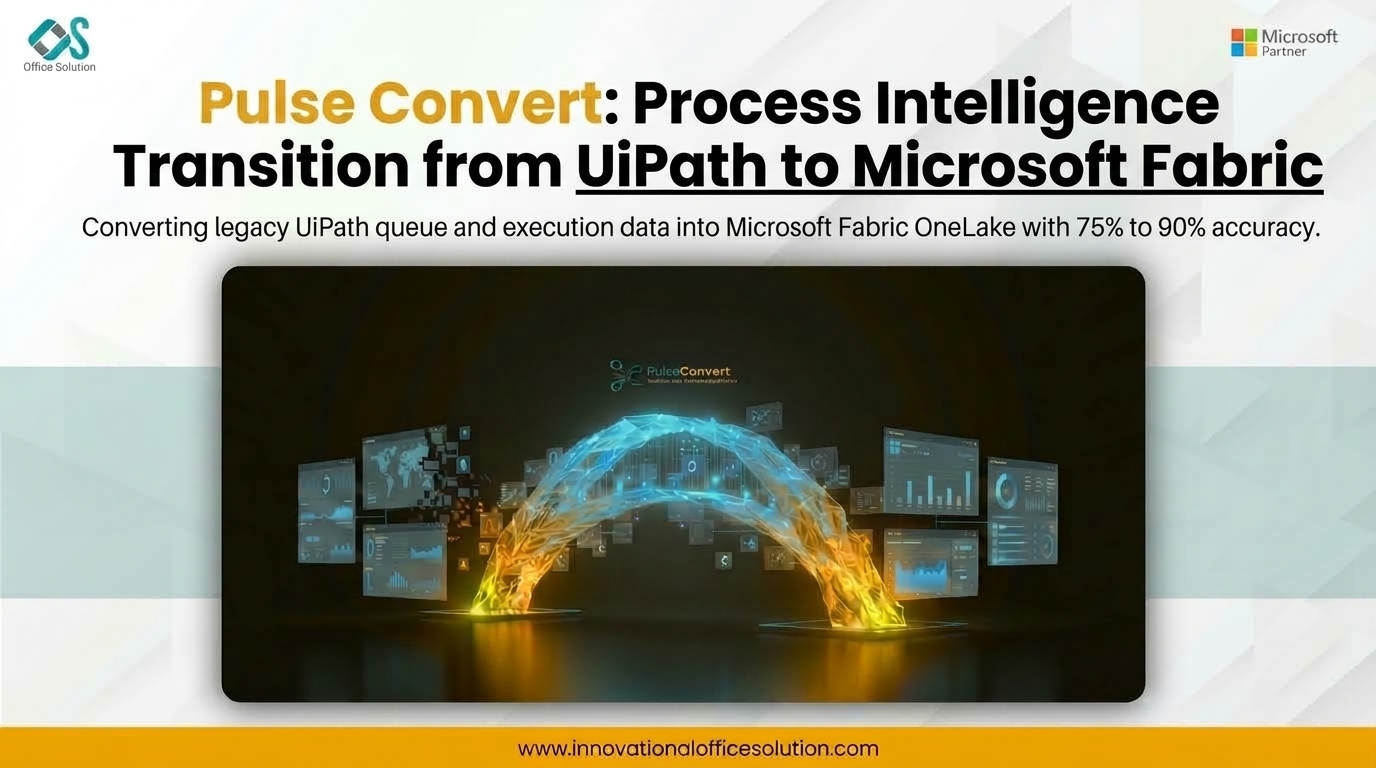
Table of Contents
Executive Summary and Business Context
A multi-national financial services institution operating across North America and Asia-Pacific relied on an extensive UiPath Robotic Process Automation (RPA) estate to process loan applications, process regulatory compliance forms, and reconcile daily transactions. Over eight years, the company deployed more than 350 active UiPath bots across various departments.
While the automations successfully executed transactional tasks, the underlying data architecture created severe analytical bottlenecks:
- Bot activity logs, queue definitions, and execution metrics were locked inside isolated SQL Server databases attached to UiPath Orchestrator instances.
- Orchestrator database retention policies automatically purged historical execution logs every 60 days to prevent performance degradation, destroying multi-year trends needed for capacity planning.
- Business leadership lacked cross-platform visibility. Comparing transaction data produced by bots against enterprise core banking data required manual ETL pipelines and custom SQL scripts.
To eliminate these silos and shift from basic task automation to real-time process intelligence, the institution initiated a comprehensive UiPath to Microsoft Fabric migration. The strategic goal was to ingest, deconstruct, and transform legacy RPA queues, transaction logs, and asset metadata directly into Microsoft Fabric’s OneLake architecture.
Technical Bottlenecks in the Legacy UiPath Setup
During the technical discovery phase, enterprise architects identified key structural challenges within the legacy RPA data layer:
- Schema Fragmentation: UiPath stores queue items, transaction histories, and asset parameters across complex, highly normalized SQL tables. Extracting meaningful business insights required expensive join operations across volatile tables.
- Short-Term Data Retention: Crucial operational telemetry was systematically purged from Orchestrator databases every two months, preventing long-term operational audits or machine learning model training.
- Data Isolation: Bot execution outputs could not be queried alongside downstream business outcomes stored in cloud warehouses without running cumbersome custom extract routines.
The Migration Engine: Pulse Convert Strategy
To avoid manually writing complex ETL pipelines for hundreds of UiPath tables and queue formats, the project team deployed Pulse Convert. Designed to deconstruct legacy relational structures and re-map them into cloud-native architectures, Pulse Convert accelerated the migration of UiPath data assets into Microsoft Fabric.
During execution, Pulse Convert evaluated the legacy schema and achieved an 85% automated architectural alignment, falling squarely within its expected 75% to 90% accuracy benchmark. Pulse Convert automatically converted raw Orchestrator queue tables, execution metrics, and variable maps into high-performance Delta Parquet tables inside Fabric OneLake. The remaining 15% of specialized XML payload fields and encrypted configuration files were refactored through targeted PySpark notebooks.
Step-by-Step Migration Roadmap
The migration from UiPath to Microsoft Fabric followed a structured five-step technical process executed over nine weeks:
Stage 1: Asset & Data Discovery [Weeks 1-2]
The team audited the UiPath Orchestrator database to identify active queue definitions, historical log volumes, assets, and environmental variables. Pulse Convert scanned the SQL database structure to identify "zombie queues"—deprecated automation records that no longer added business value—filtering them out prior to ingestion.
Stage 2: Schema Mapping & OneLake Landing [Weeks 3-4]
Pulse Convert deconstructed the relational SQL schemas and mapped them into optimized Delta Lake tables within a Microsoft Fabric Lakehouse. Static UiPath assets, server URLs, and global configurations were extracted and converted into Fabric-accessible environment variables.
Stage 3: Telemetry & Pipeline Transformation [Weeks 5-6]
Legacy Orchestrator polling schedules and Webhook triggers were replaced with Fabric Data Factory pipelines and Fabric Eventstreams. Instead of relying on static database dumps, bot execution logs were streamed directly into OneLake in real time, triggering alerts whenever exception thresholds were breached.
Stage 4: Semantic Layer & Model Building [Weeks 7-8]
Using Fabric’s SQL Analytics endpoints, raw execution logs were reorganized into a star-schema analytical model. The team built semantic models that joined bot performance metrics with core banking transaction logs, giving executives a unified view of end-to-end process efficiency.
Stage 5: Cutover, Compliance & Optimization [Week 9]
The historical log data was fully archived into compressed Delta Parquet files in OneLake, ensuring cost-effective, multi-year storage. Microsoft Purview integration was enabled across the Fabric workspace to enforce unified governance, automated indexing, and SOX compliance auditing.
Key Results and Business Outcomes
Migrating from UiPath to Microsoft Fabric delivered significant operational improvements across the organization:
- Eliminated Log Data Loss: By moving long-term storage out of operational SQL databases into OneLake, the firm retained 100% of its historical bot execution data, enabling multi-year capacity planning and process mining.
- Accelerated Migration Timeline: Pulse Convert's 85% translation accuracy reduced manual data re-architecting effort by more than 450 engineering hours, delivering the project three weeks ahead of schedule.
- Real-Time Process Visibility: By combining automation telemetry with business data in a single Fabric semantic layer, operational leaders gained instant visibility into business process health rather than just basic bot pass/fail statuses.
- Reduced Infrastructure Costs: Retiring dedicated SQL Server instances used solely for historical RPA logging generated a 28% reduction in recurring database infrastructure spend.
Accelerate UiPath to Microsoft Fabric Migration
Unify RPA telemetry, bot logs, and queue data into Microsoft Fabric OneLake with up to 90% automated schema alignment using Pulse Convert.


